Email feels like the simplest way to handle customer support when a business is small.
You put a contact address on your site, customers write in, and someone replies. At first, that seems enough. The inbox stays manageable, the team knows who is handling what, and nothing feels too complihttps://awedesk.com/why-email-alone-stops-working-for-customer-support/cated.
The problem starts when support volume grows.
What used to feel organized turns into a long thread of replies, forwarded messages, missed follow ups, and internal confusion. Customers start repeating themselves. Agents lose context. Site owners spend more time managing the inbox than solving the issue that brought the customer there in the first place.
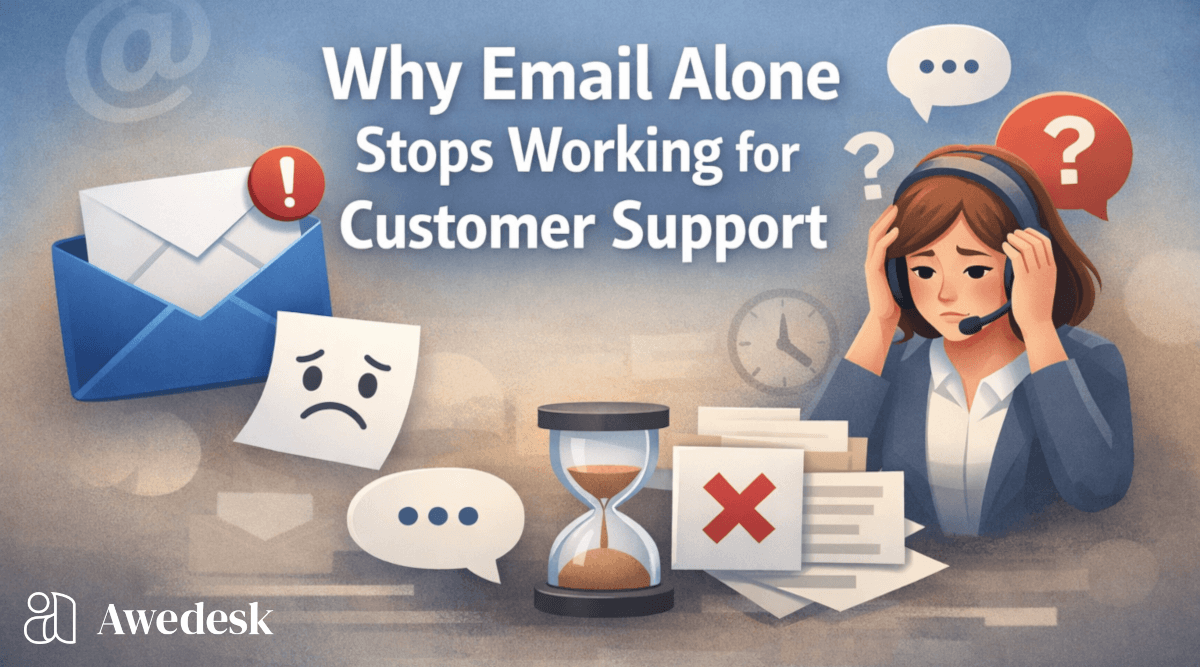
That is where email alone stops working for customer support.
Email is still useful. It remains one of the easiest ways for customers to reach a business. The real issue is that email, by itself, was never built to run a complete support operation. It works as a communication channel, not as a support system.
For WordPress site owners, creators, membership businesses, and online communities, this becomes a serious bottleneck. Once you have orders, subscriptions, member questions, technical issues, billing concerns, and community moderation requests coming into the same place, a plain inbox starts breaking down fast.
A better approach is to keep the convenience of email while giving your team the structure of a real support desk. That is where Awedesk becomes far more practical than relying on email alone.
Email works well at the beginning, then the cracks appear
Most businesses do not start with a help desk.
They start with a shared inbox like support@yourdomain.com. That feels reasonable. It is cheap, easy to set up, and familiar to every customer.
In the early stage, that setup can do the job.
A founder can read every message. A small team can manually forward conversations. People can keep track of open requests from memory or by starring messages. Customers still get replies fast enough that nobody notices the hidden inefficiencies.
Growth changes everything.
Once the number of incoming requests increases, email stops being a clear workflow and becomes a pile of conversations. The inbox shows messages, but it does not give your team a reliable operating system for support.
That creates delays, duplication, and avoidable mistakes.
The inbox does not show ownership clearly
One of the first problems with email-based support is ownership.
A customer sends a message. Several team members see it. No one is fully sure who should reply. One person assumes someone else has already handled it. Another person opens the message, plans to answer later, and forgets. A third person replies without knowing someone else was working on the same issue.
The customer experiences this as inconsistency.
They may receive two different replies. They may receive none. They may wait longer than expected while your team sorts out responsibility in the background.
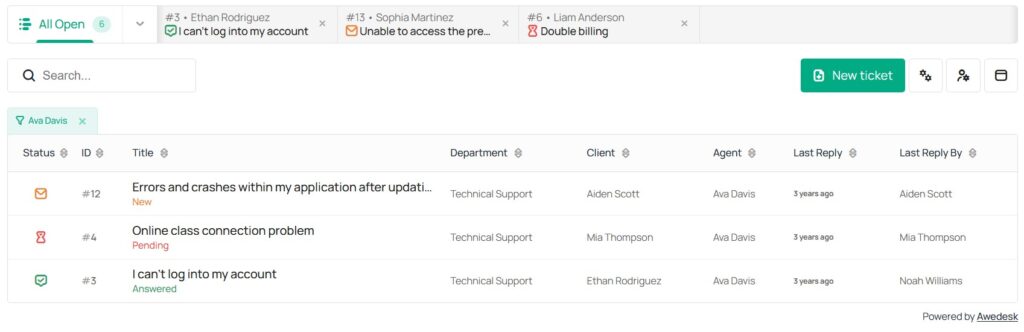
A real support workflow needs clear assignment.
Each request should have an owner. Teams should be able to see who is responsible, what the status is, and whether the issue is waiting on the customer, the agent, or another department.
With Awedesk, support requests can be assigned properly instead of being left in a shared inbox where responsibility stays vague.
Email threads hide the real support history
Email is not good at preserving support context in a clean way.
A conversation can split into multiple threads when the subject line changes. A customer may reply from a different address. Internal notes often live in separate messages or chat tools. Attachments get buried. Important details disappear as replies stack up.
The longer the thread, the harder it becomes to find what actually matters.
Support teams then waste time scrolling through old messages just to answer a simple follow up. That slows down response times and increases the chance of sending an incomplete or inaccurate reply.
Customers feel that loss of context immediately.
They have to explain the same problem again. They repeat order numbers, account details, or previous steps they already shared. That creates frustration, especially for paid members or customers who expect a smooth support experience.
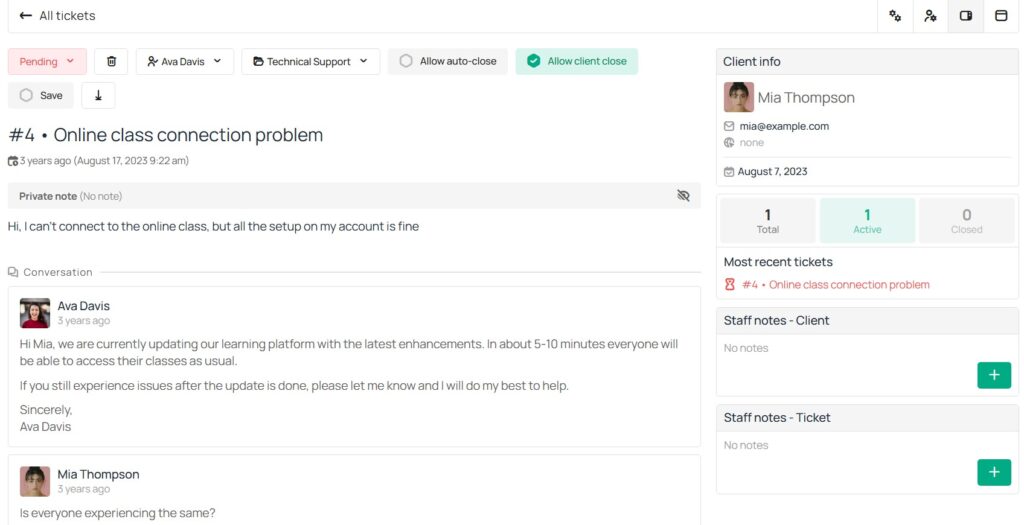
A proper ticket system keeps the conversation in one place and makes it easier for agents to understand the full story before they answer.
With Awedesk, teams can manage support as organized tickets instead of hoping every detail remains easy to find inside an email chain.
Email makes prioritization harder than it should be
Not every support request has the same urgency.
A password reset is different from a billing dispute. A course access issue is different from a product question. A technical problem affecting multiple members should not sit in the same queue as a general inquiry that can wait until tomorrow.
In a normal inbox, these requests arrive together with very little structure.
That means urgent issues can get buried under less important messages. Teams either process emails in the order they arrive or create manual workarounds that still depend too much on human memory.
This is where support quality drops.
High-priority issues wait too long. Team members jump between unrelated tasks. Customers with time-sensitive problems feel ignored, even if the team is working hard behind the scenes.
Support works better when requests are routed and categorized from the start.
Awedesk includes departments, which makes it much easier to separate billing, technical support, pre-sales questions, and other types of requests into their own inboxes. That gives site owners a cleaner structure and helps agents focus on the right work at the right time.
Internal collaboration becomes messy inside email
Customer support is rarely handled by one person forever.
Sooner or later, your support process includes team members from different roles. Someone handles refunds. Someone manages technical issues. Someone answers product questions. Someone needs to check WooCommerce orders or membership access before replying.
Email is poor at internal collaboration.
Teams forward messages. They copy coworkers into threads. They leave notes in separate tools. Private discussions get mixed with customer communication. Important decisions are scattered across inboxes, chats, and browser tabs.
The result is more internal friction.
Agents spend too much time asking each other for updates. Managers cannot easily review ticket flow. Nobody gets a clean picture of what is happening across support.
A support platform should let the team work together without turning every customer issue into a manual coordination task.
With Awedesk, internal support operations stay far more organized, especially for WordPress businesses that need to connect support with the rest of the site.
Email alone cannot scale across channels and business systems
This is where many support teams hit a wall.
Customers do not exist only in email. They also exist inside your store, your membership system, your community, your course platform, and your WordPress site itself. Their order history, access level, and account activity all shape what kind of support they need.
A plain inbox cannot connect those pieces well.
That creates a constant context gap. Agents switch between email, WooCommerce, membership plugins, user profiles, and community tools just to understand one request. Every extra tab slows down the team and increases the risk of error.
Support becomes much more effective when the help desk lives where the business already lives.
That is a major advantage of Awedesk. It works naturally inside WordPress and connects with tools site owners already depend on, including WooCommerce, Easy Digital Downloads, PeepSo, and WordPress post types.
For a membership site or creator business, that changes daily support work in a practical way.
Agents can answer with better context. Customers get faster help. Site owners keep more control because the support operation stays inside their own platform rather than being pushed into disconnected software.
Customers still want email, but teams need more than email
There is an important distinction here.
Customers often like using email because it is familiar. They do not want to learn a new portal for every business they contact. They want to send a message and get help.
That convenience should stay.
What needs to change is the system behind the message.
A strong support setup allows customers to send emails as usual while the team handles those conversations inside a structured environment. That gives customers a familiar entry point and gives your agents a better workflow.
This is why replacing email completely is usually not the best move.
The better move is to stop using email as the entire support system.
Awedesk includes email piping, which lets customers send emails normally while agents manage replies inside the help desk interface. That keeps the experience simple for the customer and much more manageable for the support team.
In practice, that means you preserve the channel without accepting the chaos of a shared inbox.
Shared inboxes also make reporting weak
Once support becomes part of business growth, you need visibility.
You need to know what kinds of issues are coming in. You need to spot recurring product problems. You need to see which department is overloaded. You need to understand whether response times are improving or slipping.
Email does not make this easy.
An inbox can show you volume at a glance, but it does not give you a clean operational picture. You are left estimating patterns manually, searching old threads, or relying on rough impressions from the team.
That hurts decision-making.
Without clear support data, product issues stay unresolved longer. Documentation gaps go unnoticed. Staffing problems remain hidden until customers start complaining publicly.
A proper support platform makes support measurable, not just reactive.
For growing businesses, that operational visibility is as important as the replies themselves.
Mobile support becomes inconsistent with email-only workflows
Support does not always happen from a desk.
Founders, support leads, and agents often need to check urgent issues while traveling, managing events, or handling work outside normal office hours. Email on mobile can help in a pinch, but it is rarely a good long-term support workflow.
It is too easy to miss important context.
Mobile email apps also make collaboration weaker. Assignment, tracking, and status management become harder. Quick replies can get sent without enough visibility into the full ticket history.
A better support setup should work on mobile without forcing teams back into the limitations of a plain inbox.
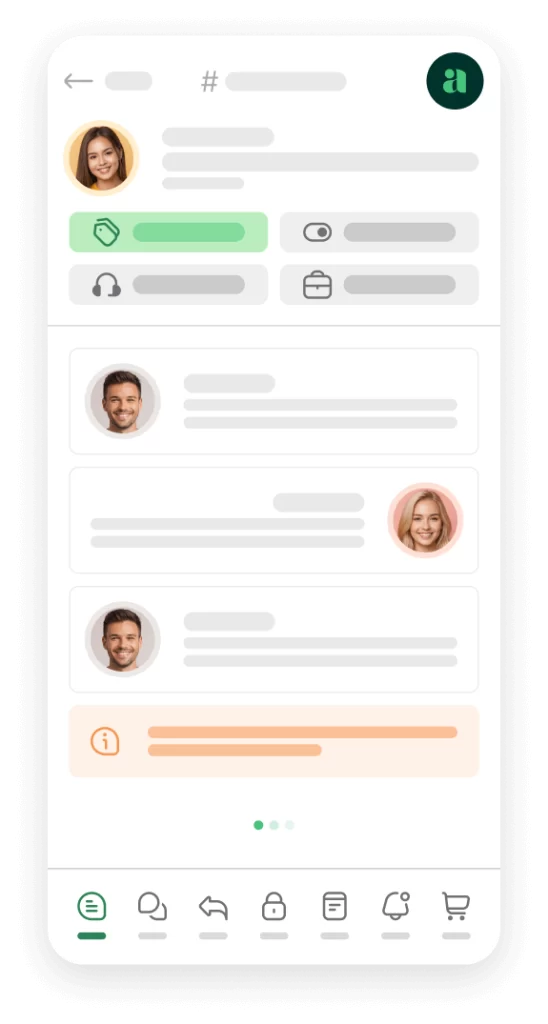
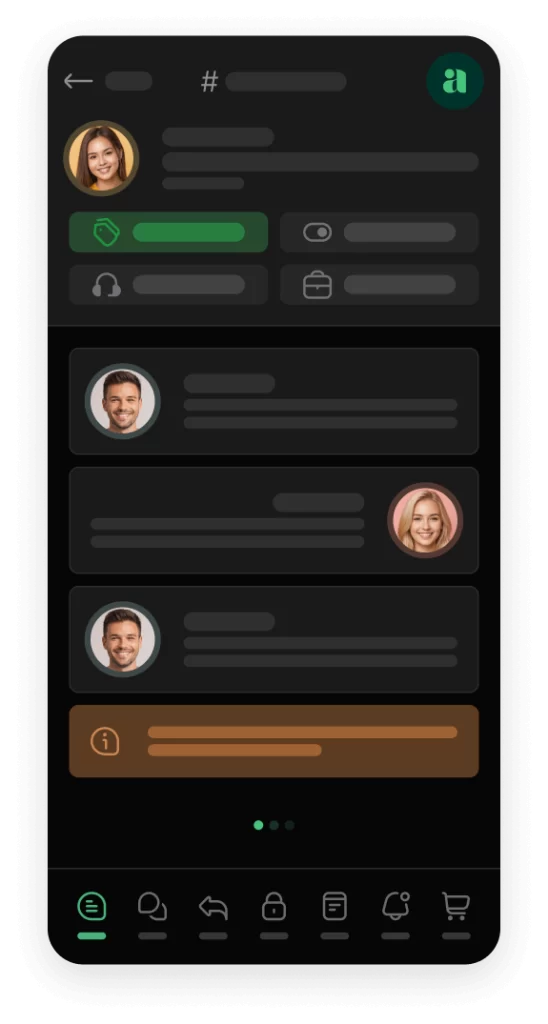
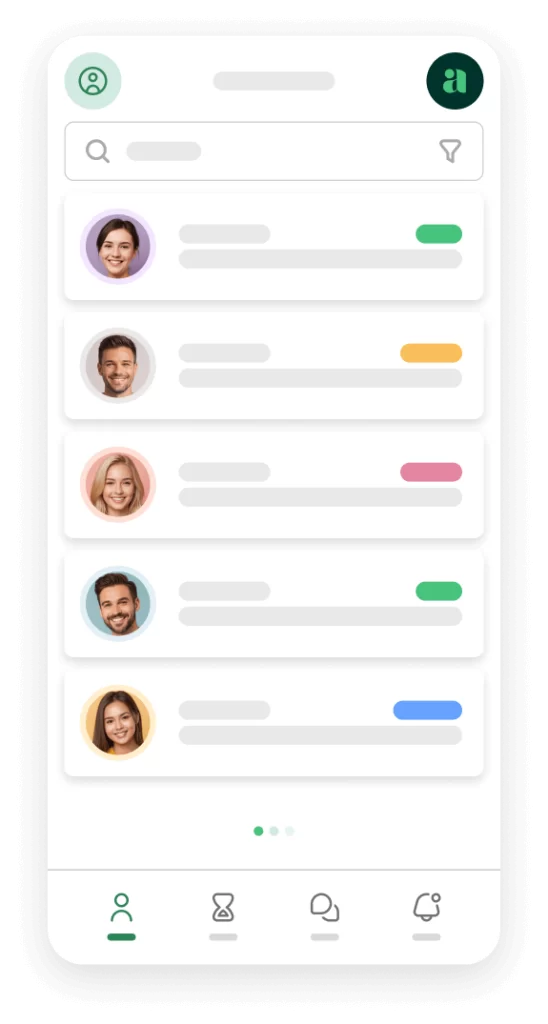
That is another practical advantage of Awedesk. It includes a native mobile app for agents, which gives support teams a more reliable way to stay responsive when they are away from the desktop.
Awedesk App
All the bells & whistles of our platform can be easily accessed on mobile, any and all of your Agents can handle any issue on the go.




Cost becomes a hidden problem with the wrong support setup
A shared inbox looks cheap.
That is one reason many businesses stay with email longer than they should. On the surface, it feels like the low-cost option.
The hidden cost appears in lost time, duplicated replies, slower resolution, and poor coordination. Support teams spend extra minutes on every ticket just figuring out what happened and who should do what next. Over time, those inefficiencies become expensive.
Then comes the next problem.
Many businesses outgrow email and jump straight into external help desk software that adds another layer of cost, complexity, and platform dependence. Per-agent pricing rises. Ticket limits become frustrating. The system lives outside WordPress. The team pays more but still works around integration gaps.
For WordPress site owners, that is often the wrong tradeoff.
Awedesk gives businesses a more practical path. You keep support close to your site, avoid the sprawl of disconnected tools, and get a fixed-price model without limits per agent or ticket. That makes planning simpler for businesses that expect support volume to grow.
What to do instead of relying on email alone
The solution is not to remove email from support.
The solution is to put email inside a better structure.
Start by separating communication from workflow. Let customers continue using email if that is the easiest entry point, but make sure your team handles those requests as tickets with ownership, status, routing, and context.
Next, organize support by function.
Use separate departments for sales questions, billing issues, technical support, and member-related requests. This reduces confusion and makes response quality more consistent.
Then connect support to your WordPress business.
When support lives close to your store, community, and membership tools, agents can solve problems faster because they are not piecing together the customer journey from scattered systems.
Finally, choose a system that can grow with the team.
That means support should work for one founder today and still work when you have multiple agents, higher ticket volume, and more specialized workflows tomorrow.
For WordPress businesses, Awedesk does that in a way email alone never can.
Conclusion
Email is still useful for customer support, but it stops working when it becomes the whole system.
The moment support volume grows, a plain inbox starts creating confusion around ownership, priority, collaboration, and context. Customers feel that breakdown through slower replies, repeated explanations, and inconsistent service. Teams feel it through wasted time and constant coordination issues.
The better move is to keep email as a channel while upgrading the support operation behind it.
That is where Awedesk stands out for WordPress site owners, creators, and membership businesses. It keeps support inside WordPress, adds structure through tickets and departments, supports email piping, gives agents mobile access, and removes the limits that often make external help desk software harder to justify over time.
When support becomes part of growth, email alone is no longer enough.
A real help desk built for WordPress is the next step, and Awedesk is the practical way to make that transition without losing the convenience customers already expect.